Herstein Topics In Algebra Solutions Chapter 6 Pdf Work

Build confidence, precision, and consistency — with the most advanced practice app for musicians. The app trusted by Broadway musicians, Juilliard students, and teachers worldwide.

Trusted by 1M+ musicians worldwide
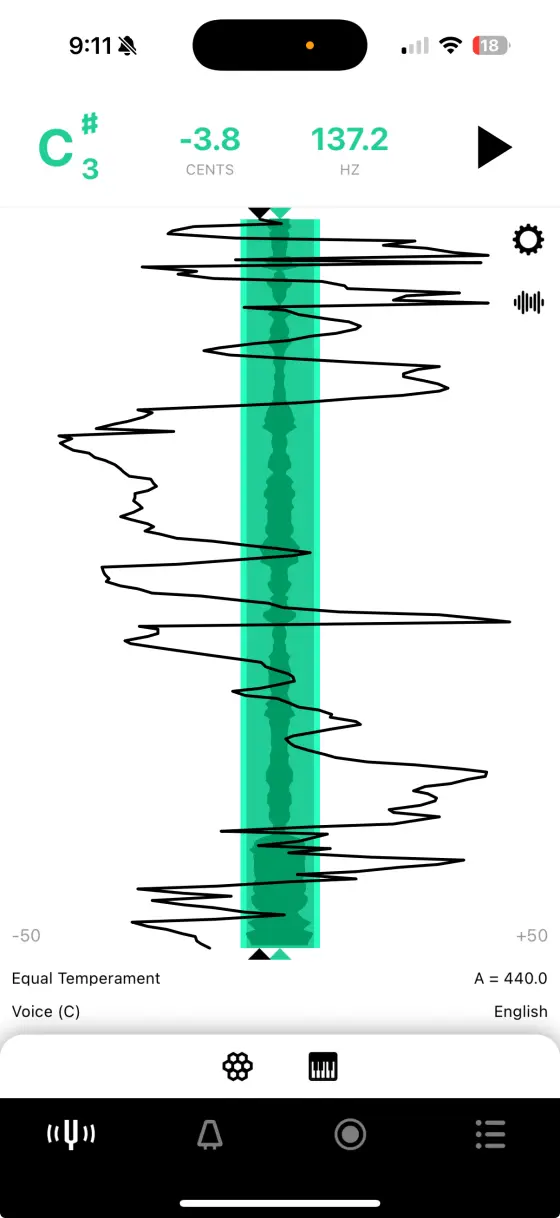
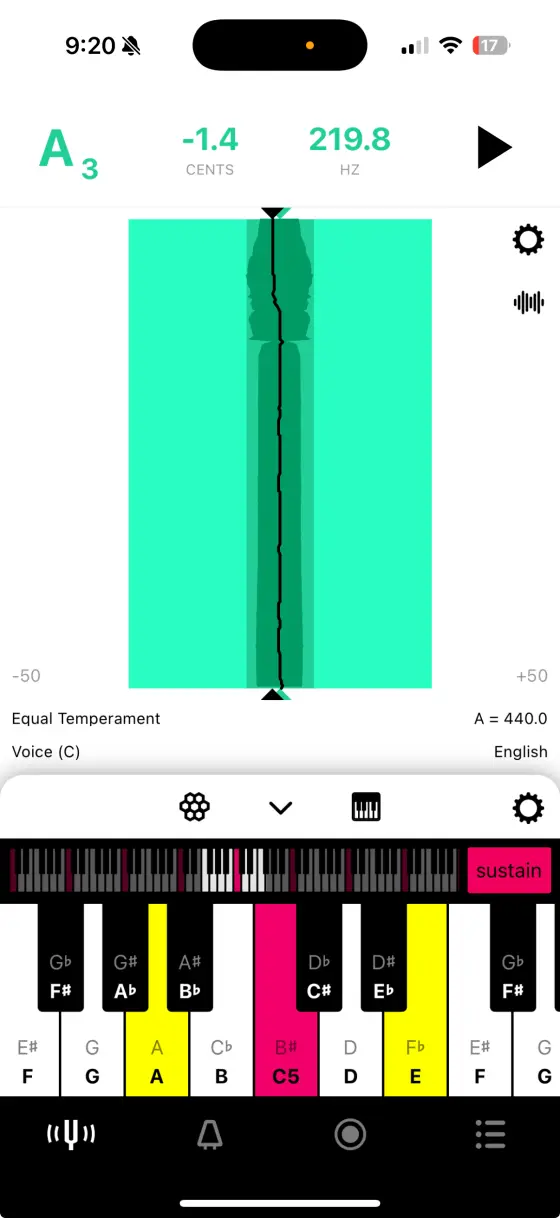
Tunable chromatic tuner showing real-time pitch detection and Sustained Pitch History

Trusted by millions worldwide

The best tuner, metronome, and recorder on iOS and a pitch-perfect bargain for any musician.
MacLife • Technology Review

Trusted by

Tunable is used by students and faculty at the Juilliard School, Berklee College of Music, Broadway productions, and Music Teachers Association members worldwide.

World map showing Tunable users across six continents
For Every Musician

From classroom to concert hall

Tunable grows with you. Start as a beginner, develop your skills, and join the ranks of professionals who rely on Tunable every day.

🎓

Students & Beginners

Build confidence with practice feedback and clear visual cues

🎭

Professional Musicians

Broadway musicians and Juilliard students trust Tunable for precision

👨‍🏫

Music Teachers

Share recordings and track student progress with detailed analytics

Young student taking first steps in music with Tunable practice app

First Steps

"Perfect for building confidence in young musicians"

Beginner
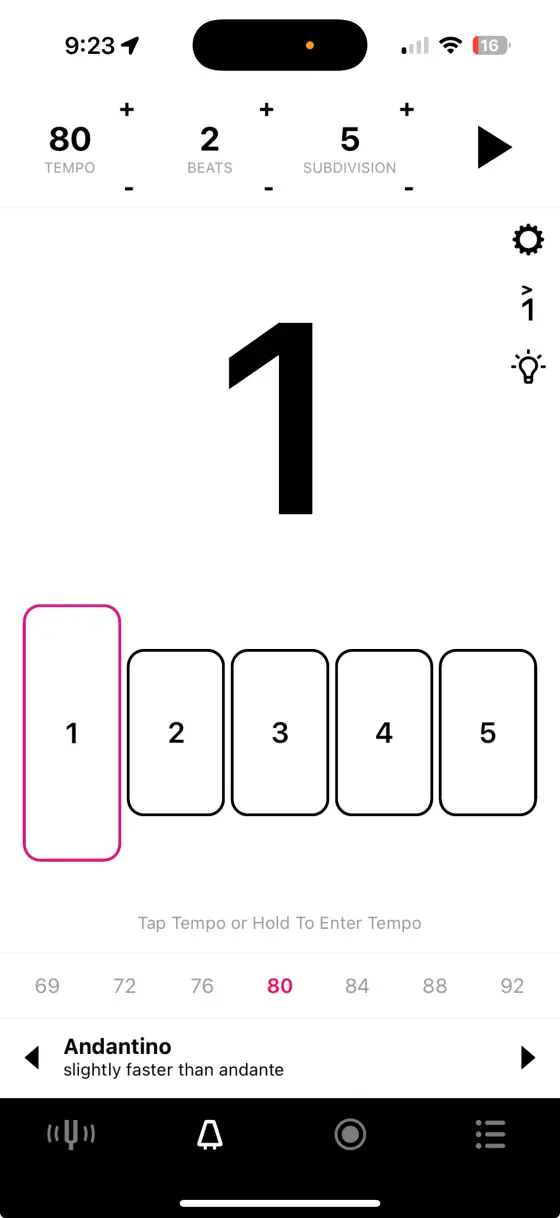
Students practicing together in ensemble using synchronized metronome

Ensemble Practice

"Synchronizes timing across multiple instruments"

School Band
Student performing at Juilliard recital after practicing with Tunable

Elite Training

"Trusted by conservatory students worldwide"

Juilliard
Professional Broadway orchestra musicians who use Tunable

Broadway Orchestra

"Trusted by professional musicians on Broadway stages"

Broadway

Herstein Topics In Algebra Solutions Chapter 6 Pdf Work

: High-quality manuals focus on helping students "cultivate a profound understanding" rather than just giving answers. However, some student-made PDFs may contain errors or overly concise steps that require additional breakdown. Difficulty Alignment

), and the foundational result that every group is isomorphic to a subgroup of a permutation group (Cayley's Theorem).

In Chapter 6 of "Topics in Algebra", Herstein introduces the concept of modules and algebras. A module is an abelian group together with an operation of scalar multiplication that satisfies certain properties. Algebras are also discussed, which are vector spaces equipped with a bilinear multiplication operation. The chapter covers various topics, including:

If you do locate a reliable, legally questionable PDF (or better, a legitimate student-written solution set shared with permission), what will you find? The best solutions for Herstein Chapter 6 generally include:

Several users have created repositories containing LaTeX-typed solutions for Herstein's Topics in Algebra .

Herstein asks: Prove that the vector space of all polynomials over a field ( F ) is infinite-dimensional. A good solution will not just state "because you can find arbitrarily many linearly independent polynomials" but will prove by contradiction using the definition of basis.

Chapter 6 is critical because it bridges pure abstract algebra (groups, rings, fields) with linear algebra. Key sections typically covered include: East Tennessee State University The Algebra of Linear Transformations : Fundamental properties and operations. Characteristic Roots : The study of eigenvalues and eigenvectors. : A formal abstract treatment of matrix algebra. Canonical Forms

Inner product spaces and the special classes of operators acting on them. Why Chapter 6 Solutions Are Highly Sought After

Algebraic properties of matrices and their underlying transformations.

Before diving into the exercises, it is vital to understand the mathematical pillars Herstein establishes in this chapter. Chapter 6 shifts the focus toward vector spaces and modules, exploring how linear transformations can be broken down into simpler, invariant components. 1. Vector Spaces and Linear Transformations

Triangular form, Jordan form, and Rational canonical form. 6.5 Nilpotent Transformations: Studying transformations

Sites like Wikibooks and personal student repositories on GitHub offer detailed, typed-up proofs for many of the challenging exercises.

Have you worked through Herstein’s Chapter 6? Which problem tripped you up the most? Share your experience in the discussion below.

Navigating abstract algebra requires the right resources, and I.N. Herstein’s Topics in Algebra remains one of the most influential textbooks in advanced mathematics. Chapter 6, which covers Linear Transformations, represents a critical transition from abstract group and ring theory into the geometric and algorithmic structures of vector spaces.

: Fundamental definitions and properties of transformations between vector spaces.

Solutions must clearly state what basis is being used when translating a transformation into a matrix representation

specifically, including step-by-step proofs for problems on nilpotents and algebras over a field. Academia.edu : Hosts various user-uploaded solution PDFs for Topics in Algebra

: Advanced topics like triangular, nilpotent, and Jordan forms are typically addressed in the latter half of this chapter. Inst Hour: 6 - KNGAC


: High-quality manuals focus on helping students "cultivate a profound understanding" rather than just giving answers. However, some student-made PDFs may contain errors or overly concise steps that require additional breakdown. Difficulty Alignment

), and the foundational result that every group is isomorphic to a subgroup of a permutation group (Cayley's Theorem).

In Chapter 6 of "Topics in Algebra", Herstein introduces the concept of modules and algebras. A module is an abelian group together with an operation of scalar multiplication that satisfies certain properties. Algebras are also discussed, which are vector spaces equipped with a bilinear multiplication operation. The chapter covers various topics, including:

If you do locate a reliable, legally questionable PDF (or better, a legitimate student-written solution set shared with permission), what will you find? The best solutions for Herstein Chapter 6 generally include:

Several users have created repositories containing LaTeX-typed solutions for Herstein's Topics in Algebra .

Herstein asks: Prove that the vector space of all polynomials over a field ( F ) is infinite-dimensional. A good solution will not just state "because you can find arbitrarily many linearly independent polynomials" but will prove by contradiction using the definition of basis.

Chapter 6 is critical because it bridges pure abstract algebra (groups, rings, fields) with linear algebra. Key sections typically covered include: East Tennessee State University The Algebra of Linear Transformations : Fundamental properties and operations. Characteristic Roots : The study of eigenvalues and eigenvectors. : A formal abstract treatment of matrix algebra. Canonical Forms

Inner product spaces and the special classes of operators acting on them. Why Chapter 6 Solutions Are Highly Sought After

Algebraic properties of matrices and their underlying transformations.

Before diving into the exercises, it is vital to understand the mathematical pillars Herstein establishes in this chapter. Chapter 6 shifts the focus toward vector spaces and modules, exploring how linear transformations can be broken down into simpler, invariant components. 1. Vector Spaces and Linear Transformations

Triangular form, Jordan form, and Rational canonical form. 6.5 Nilpotent Transformations: Studying transformations

Sites like Wikibooks and personal student repositories on GitHub offer detailed, typed-up proofs for many of the challenging exercises.

Have you worked through Herstein’s Chapter 6? Which problem tripped you up the most? Share your experience in the discussion below.

Navigating abstract algebra requires the right resources, and I.N. Herstein’s Topics in Algebra remains one of the most influential textbooks in advanced mathematics. Chapter 6, which covers Linear Transformations, represents a critical transition from abstract group and ring theory into the geometric and algorithmic structures of vector spaces.

: Fundamental definitions and properties of transformations between vector spaces.

Solutions must clearly state what basis is being used when translating a transformation into a matrix representation

specifically, including step-by-step proofs for problems on nilpotents and algebras over a field. Academia.edu : Hosts various user-uploaded solution PDFs for Topics in Algebra

: Advanced topics like triangular, nilpotent, and Jordan forms are typically addressed in the latter half of this chapter. Inst Hour: 6 - KNGAC
Start your musical journey today

Join millions of musicians who practice with confidence. Download Tunable and discover what you're truly capable of.

Works on iPhone and Android
No ads, no subscriptions required